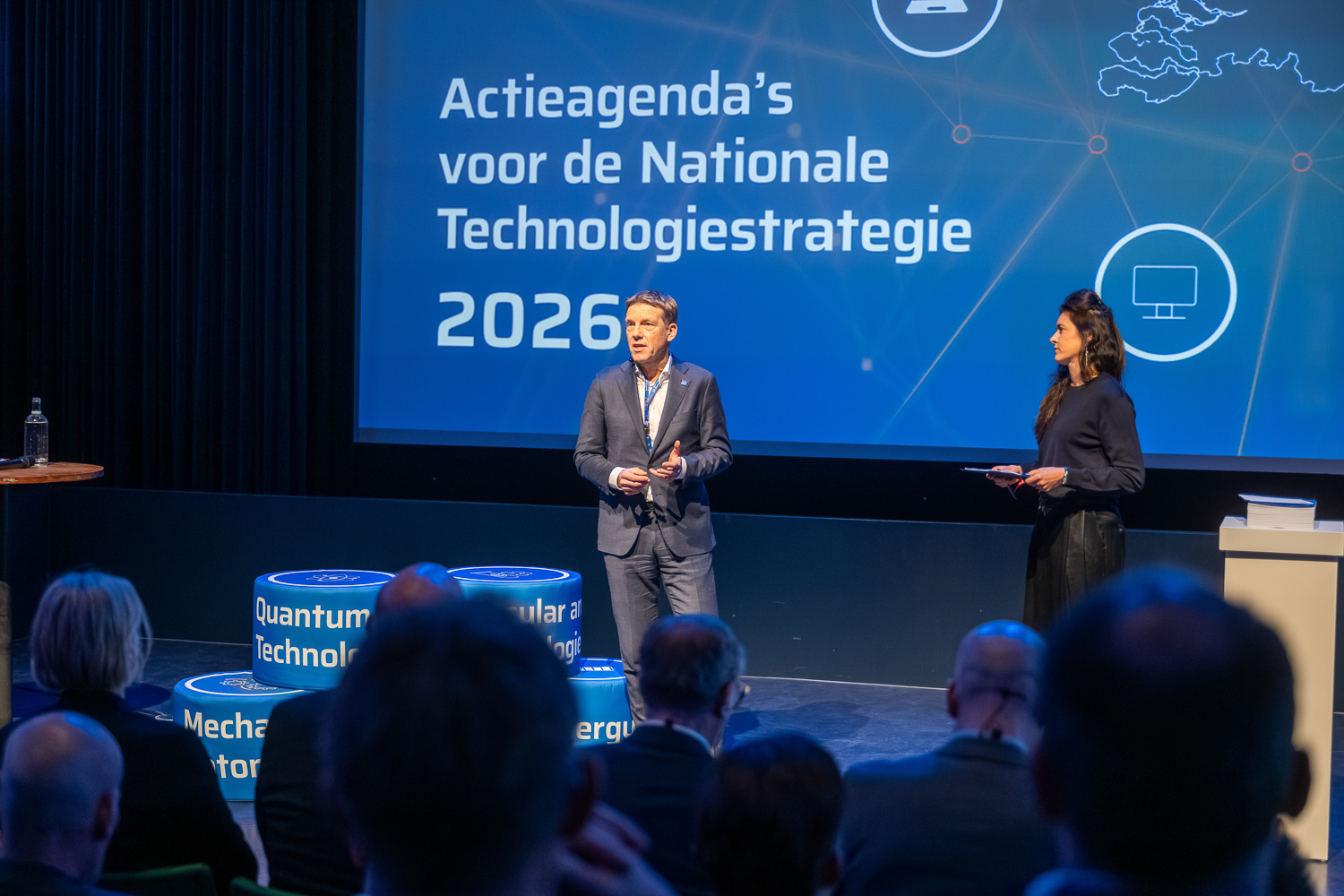
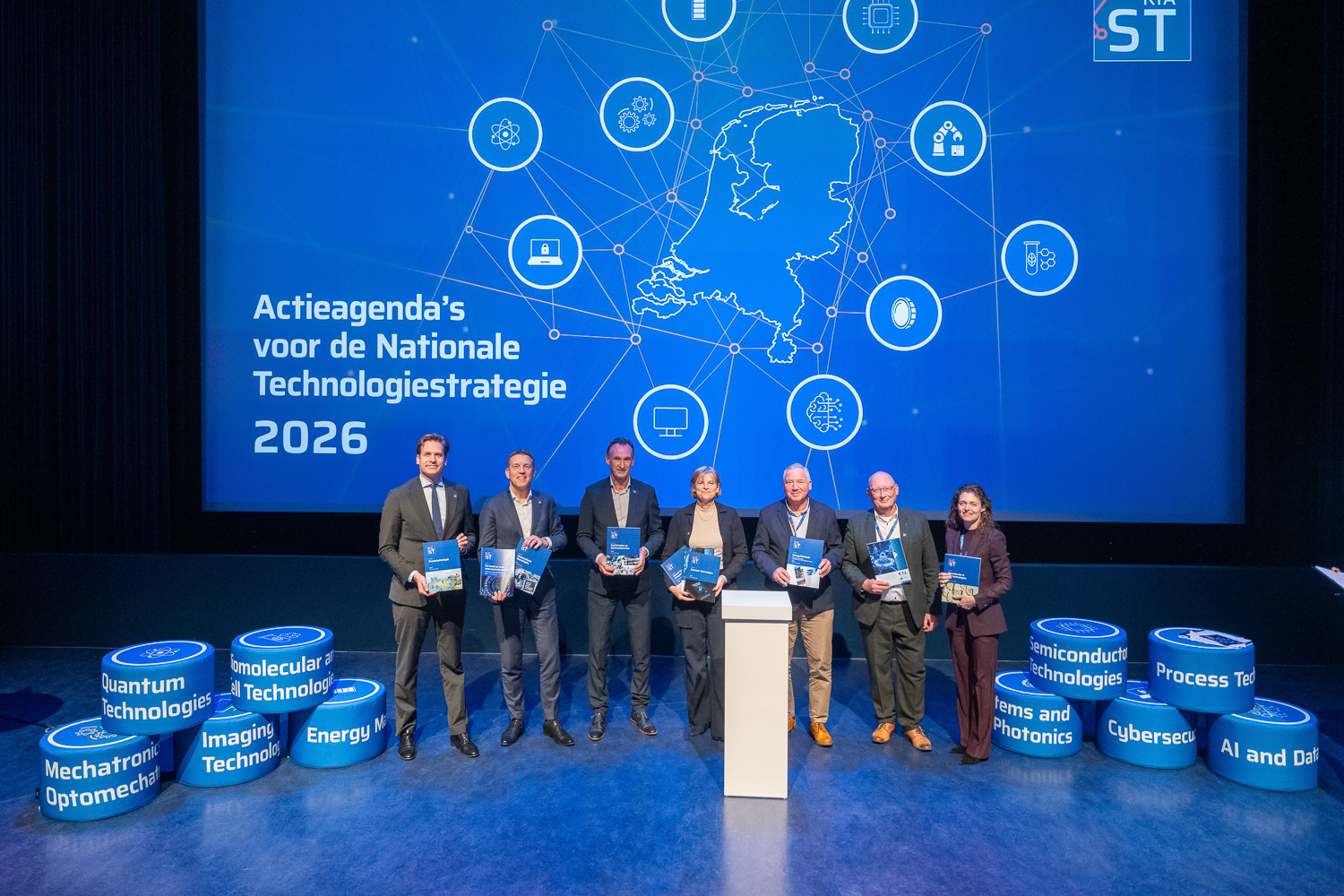
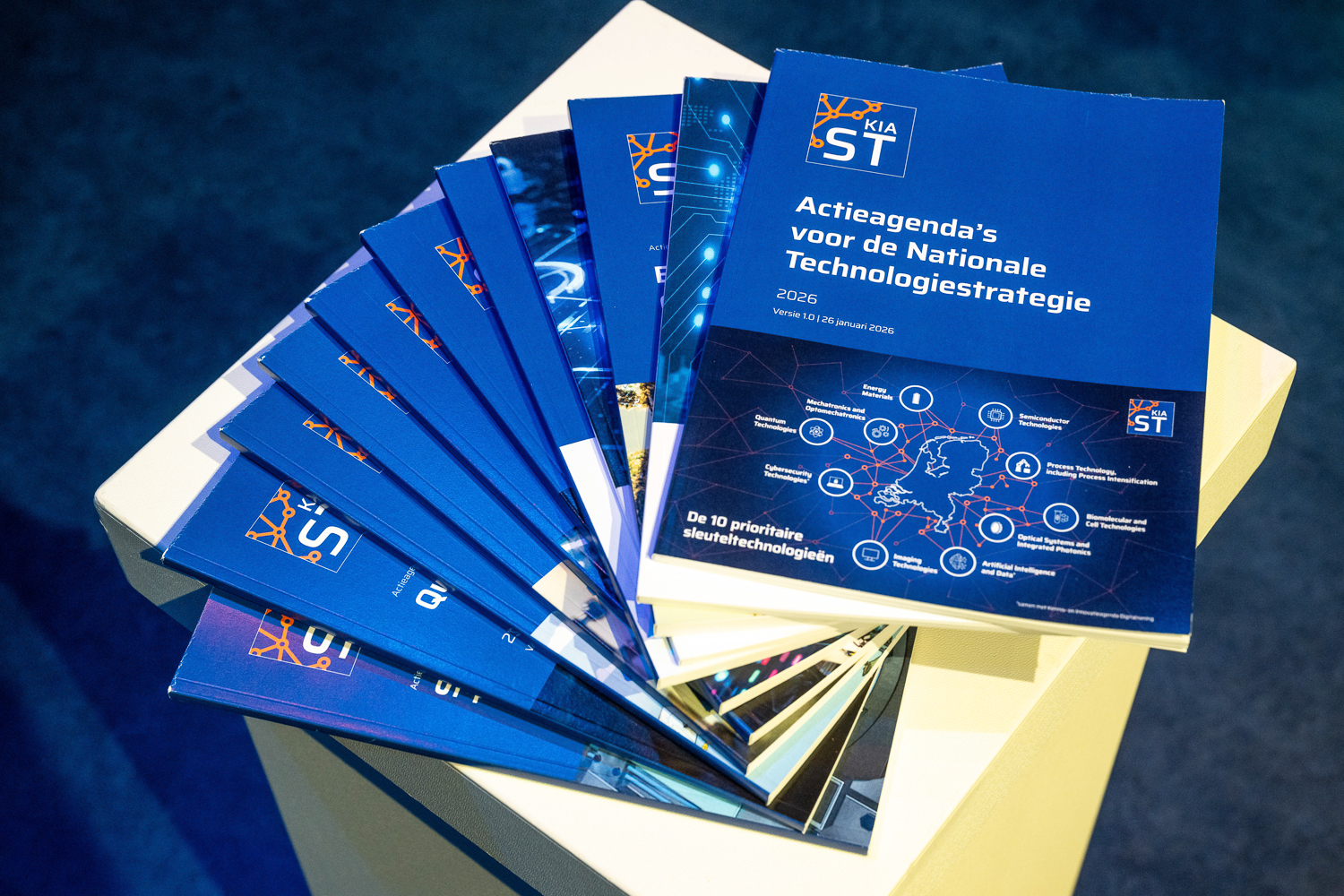
On Monday, 26 January 2026, the details of the National Technology Strategy (NTS) for 2035 were presented at the NEMO Science Museum. The ambition of the NTS has been translated into ten action agendas with 53 innovation programmes and an investment proposal of more than 14 billion euros. The aim is to establish a clear ambition and technological course for the Netherlands, with a focus on AI, quantum technology and semiconductors, among other things. Minister Vincent Karremans was present, as were important representatives from knowledge institutions, government and the business community.
The ten action agendas show specifically which technological breakthroughs, applications and ecosystems are needed to enhance the strategic position and earning capacity of the Netherlands and to strengthen the position of our start-ups, scale-ups, SMEs and large companies. At the same time, they are indispensable for solving the social challenges we face.
More than a thousand organisations contributed to the plans. The result: 53 innovation programmes. From knowledge institutions to multinationals and from start-ups to regional development companies (ROMs): the entire chain was involved.
Aftermovie
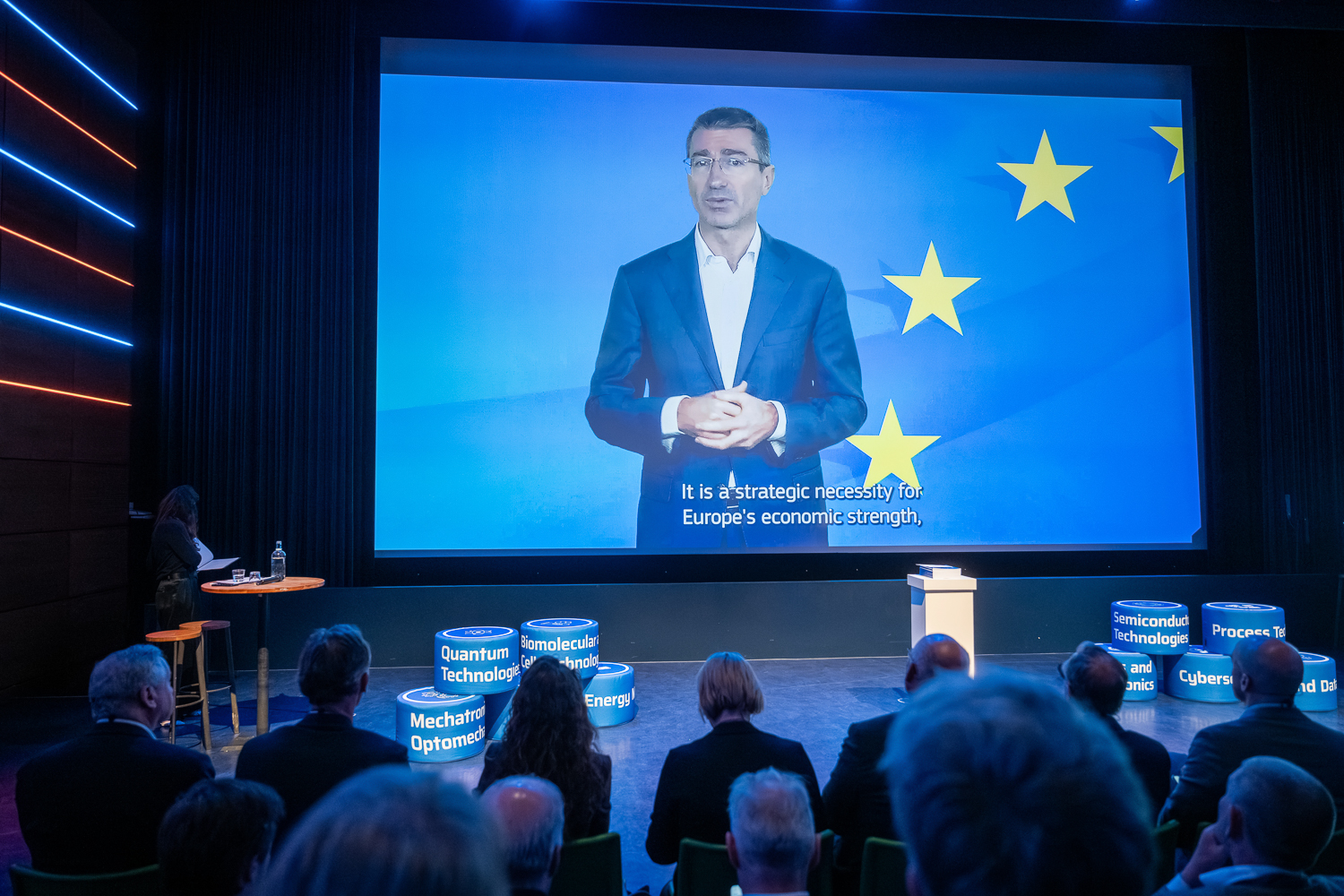
View the highlights of the event at which the ten action agendas were officially presented and at which various speakers, including Marc Lemaître, Director-General for Research and Innovation at the European Commission, and Minister Karremans, made an appearance, led by Eva de Mol.
Strategic context
Minister Karremans outlined current international developments, in which technological independence is important. According to him, it is important that the Netherlands maintains a strong position in key technologies and that cooperation with other countries is organised efficiently.
Vincent Karremans, Minister of Economic Affairs:
The Netherlands has a strong starting position in key technologies, with a wealth of talent, technological knowledge, innovative strength and a robust business community. The action agendas come at the right time, in a period of geopolitical and economic pressure in which targeted investments in innovation, technology and strategic autonomy are necessary. Because we, as a relatively small country, have to make choices and build on our strengths, it is essential that investors also structurally link up with the innovation programmes from these action agendas. Together, we can successfully bring the technologies from the National Technology Strategy to market, increase our earning capacity and contribute to the autonomy of the Netherlands and Europe.
Peter Stolk, chair of the Key Technologies Knowledge and Innovation Agenda, says about the action agendas:
We are delighted that these action agendas reveal an innovative capacity worth more than €14 billion. The 53 innovation programmes showcase both existing activities that we will continue to expand and new innovations that will help the Netherlands strengthen its international strategic position. At the same time, these action agendas help us to make targeted choices. And this is just the beginning. We will immediately continue with the next steps in collaboration, financing, upscaling and internationalisation – together with all parties involved and new partners who are already ready to join this strong innovation ecosystem.
European perspective
Cooperation within Europe also remains important. Minister Karremans pointed out the need for an internal market. Marc Lemaître of the European Commission emphasised in a video message that the Netherlands has a strong position in innovation in Europe, including in optical systems, quantum technology and semiconductors.
Marc Lemaître, Director-General for Research and Innovation at the European Commission, said in a video message that the Netherlands serves as a fine example for Europe.
Marc Lemaître, Director-General for Research and Innovation at the European Commission:
The Netherlands has long been a powerhouse of innovation in Europe. Your impressive work of preparation of the action agendas to implement the National Technology Strategy dovetails perfectly with Europe's ambition to be more competitive and resilient in a rapidly changing world. […] What you are developing nationally strengthens Europe as a whole. Leadership in key enabling technologies is of vital importance. In a world of accelerating technological change and growing weaponization of resource and technologies, investing in areas such as AI, quantum, semiconductors, biotechnology, advanced materials, cybersecurity and advanced optical systems is a strategic necessity for Europe's economic strength, security and resilience. […] Europe's future competitiveness will be built by shared ambition, cooperation and European scale. By its National Technology Strategy and strong participation in Horizon Europe, the Netherlands is in fact showing the way.
The ten action agendas
The action agendas are a starting point for further joint innovation. In the coming years, efforts and cooperation on priority key technologies will be further linked and aligned with other (recent) reports and developments, including the Wennink Report, the Regional Reinforcement Plan for the National Technology Strategy (RV-NTS) of the Regional Development Agencies, the National Growth Fund Programmes and European initiatives.
In the accompanying umbrella publication for the ten action agendas, KIA ST provides the context for the joint efforts of the business community, knowledge institutions and government bodies around the ten priority key technologies that will determine the future earning capacity, strategic autonomy and broad prosperity of the Netherlands. In addition, they identify the preconditions necessary to realise the ambitions of the NTS.
Role of TKIs in the action agendas
Without funding, there can be no action in the action agendas. During the panel discussion in which the KIA ST theme team spoke about the next steps for realising the ambitions of the action agendas, one of the topics was the funding of the innovation programmes. The action agendas describe which parts will be realised with existing funding and where new funding is needed, both public and private.
The Relevant Top Consortia for Knowledge and Innovation (TKIs; ChemistryNL, Digital Holland, Health~Holland and Holland High Tech) play an important role in the existing funding. With their use of funds from the PPS-I scheme, they contribute to important NTS action agenda programmes. The directors of these four TKIs spoke in videos about their contributions to the ten action agendas.
Dutch High Tech
Holland High Tech coördineert de KIA ST en is nauw betrokken bij de actieagenda’s Optical Systems and Integrated Photonics, Quantum Technologies, Imaging Technologies, Mechatronics and Optomechatronics, Energy Materials en Semiconductor Technologies.
Leo Warmerdam, director of Holland High Tech, on the importance of the action agendas and the role that Holland High Tech plays in this.
Leo Warmerdam, Director of Holland High Tech:
We ensure that the parties involved work together effectively and increase their collective clout.
Health~Holland
Nico van Meeteren, Managing Director of Health~Holland, on the importance of the Biomolecular & Cell Technologies action agenda, the role of Health~Holland and the Organ-on-a-Chip innovation programme.
Digital Holland
Frits Grotenhuis, Director of Digital Holland, on the role of Digital Holland in the AI & Data and Cybersecurity action agendas.
ChemistryNL
Peter Berben, Managing Director of ChemistryNL, on the support ChemistryNL provides to the Process Technology action agenda.
Holobox: a glimpse into 2035
To make the impact of the plans tangible, the audience at NEMO was taken on a journey via a so-called 'Holobox'. This virtual demonstration showed a vision of the Netherlands in 2035. It clearly illustrated how cooperation and integration of the action agendas can strengthen the ecosystem, with examples such as robotics, drones, energy-efficient AI, quantum computing and laser satellite communication.
Focus and cooperation
The action agendas provide clear direction for the future of technology in the Netherlands. ‘Focus’ was therefore a recurring theme in various presentations.
Eline van Beest, Chief Executive Officer of Hybridise Therapeutics:
A long-term focus is essential for entrepreneurs and investors. Technology needs five to ten years to reach the market.
Lukas Roffel, CTO of Thales Netherlands, emphasised the importance of letting go of non-priorities and strengthening cooperation between technologies:
Formulating priorities is not the most difficult part of policy-making. The real challenge lies in letting go of non-priorities. Innovation policy has a natural tendency to become fragmented: every technology seems important, every sector has a valid claim and every region wants to participate. The result is often a dilution of resources, fragmentation of initiatives and a lack of scale and clout. Strategic autonomy requires sharp choices. This means that we must explicitly ask ourselves where we can realistically build or maintain global leadership, which technologies are essential to our security and prosperity, and where we can create dependencies that are mutually beneficial rather than risky. This is the basis for the Netherlands' future earning capacity.
Of course, many other parties in the Netherlands have also started working on the National Technology Strategy. KIA ST is actively seeking cooperation with all these parties through the action agendas and at the governance level. The action agendas are a starting point for further joint innovation.
Rinke Zonneveld (CEO Invest-NL), Constantijn van Oranje (Special Envoy, Techleap) and Wendy de Jong (Managing Director Oost NL and National Chair ROM-Nederland) on how to actually move from NTS to action.
Next steps
In the coming years, cooperation on key technologies will be aligned with existing plans, funds and (European) initiatives, from the Wennink Report to the National Growth Fund.
Peter Stolk, chair of the Key Technologies Knowledge and Innovation Agenda (KIA ST), on the way forward:
I hope and trust that the new coalition will take a long-term approach. The NTS is a kind of breeding ground for strengthening the Netherlands' innovation and industrial policy, making the Netherlands more autonomous and shaping the economic earning capacity of the future.
On behalf of all those involved in the action agendas, we call on interested parties to join these action agendas, to link their ambitions and initiatives to the NTS action agendas, and to take the step from planning to implementation together. Together, we can develop new technological breakthroughs for the prosperity, well-being and resilience of a future-proof Netherlands.